
"The Sun Was Never Just Red"
When I was a child, my father's work took our family to Madrid, Spain. This was about fifty years ago, long before Japan even had Narita Airport, and back then, very few Japanese people had ever heard of Spain. People there often mistook me for Chinese, and every time, I'd correct them: "I'm Japanese!"
After we moved back to Japan, I started at a local elementary school. During an art class, every single classmate drew the sun in red. I drew mine in yellow. My teacher told me, "The sun is red." I still remember how much that stung. In Spain, the sun could be orange, red, yellow—maybe even pink. No one ever told me there was a wrong color to choose.

"The Rule I Broke to Find Myself"
That drawing was just one small moment, but growing up in Japan, I often felt like the odd one out. School felt rigid, and it never quite fit who I was. In high school, I found a part-time job at a McDonald's on a U.S. military base. My school's rules were strict—working a part-time job could get you expelled if you were caught. But I wanted nothing more than to build a life overseas, and I knew that meant mastering English first. So I took the risk.
Inside the base, English was the everyday language, the U.S. dollar was the currency, and the menu followed American sizes and standards. Every so often, Japanese customers would come in and pay in yen. Everything ran on multiple systems at once, and I found it endlessly interesting.
Almost no one ordered straight off the menu. "No onions." "Extra pickles." "No mustard." "A medium Coke in a large cup, extra ice." Customizing your order was simply the norm. I don't know if it's still like that today, but that experience taught me something: this—the freedom to shape things your own way—was what felt right to me.

“The Place Where "Normal" Didn't Exist”
As an adult, I finally landed the job I'd long dreamed of, in Hong Kong. My colleagues came from all kinds of countries, and there was no such thing as everyone being the same. I felt completely at home there, and I went on to live in the UK and Belgium as well.
But wherever I lived abroad, people always asked me the same kinds of questions: about Japanese culture, Japanese customs. And that's when it hit me—I didn't actually know much about my own country. That realization sparked a desire to learn about Japan properly, so I could finally share it with others.
"Freedom, Hidden Inside Tradition"
Back in Japan, I wanted to learn more about Japanese culture, so I began practicing the way of tea. Through my master and the community around her, I came to see something I hadn't expected: beneath all the formal traditions and set forms, there was a deeply free spirit at work.

"The Cloth That Was Always There"
Looking back, furoshiki had always been part of my life. The arabesque-patterned one that wrapped our futon in the closet. The silk ones my grandmother and mother used. The furoshiki I carried my belongings in at tea gatherings.
Then, one day, traveling in Kyoto with friends from abroad, I overheard one of them say, "Let's get a furoshiki as a souvenir." Something clicked. A single piece of cloth could take whatever shape the person using it wanted—there was no one right way. I'd taken a bit of a roundabout path to get there, but the joy of deciding for yourself—that was exactly what I'd been feeling all along.

"Finding My Roots in Yokohama Nassen"
As I dove deeper into this journey, I discovered something I never expected: my own hometown carried a rich dyeing history of its own. About 120 years ago, Yokohama Nassen (Yokohama dyeing) emerged as one of Japan's leading textile industries, pushing traditional techniques in new directions—a place where craftsmanship and innovation grew up side by side.
Suddenly, it all clicked. This was my connection, my foundation, my home. I hadn't just stumbled onto a passion—I'd been walking a path that generations before me had already paved, without even realizing it.
Looking back on the roundabout road that led me here, I finally understood something about myself: I'd found my own sense of self in furoshiki. What I truly love, it turns out, is coming into contact with different cultures. Furoshiki isn't only about preserving tradition—it's about evolving it, making it relevant, and carrying it forward. What I create today hopuflly become a bridge, one that connects the past to the future.
"Why I Started MUSUBISM"
I wanted more people—around the world, and in Japan too—to discover the freedom that furoshiki has to offer. That's why I started MUSUBISM.
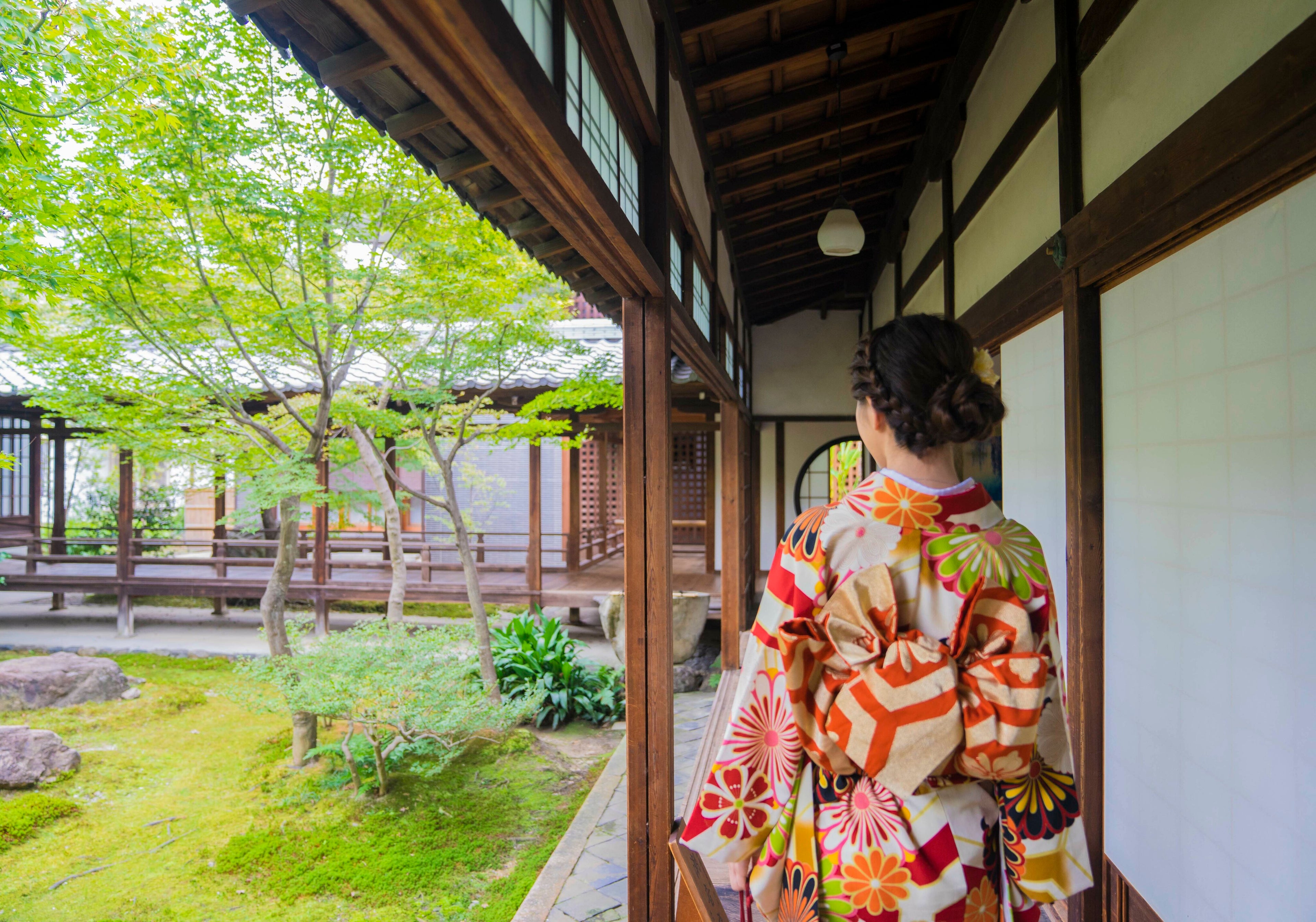
The only time I wear a kimono these days is for something related to tea ceremony, or something related to kimono itself. I love kimono, so I've been studying how to style and coordinate it. My home doesn't have a traditional Japanese-style room. I wear jeans, I lean toward that easy, low key kind of look—casual is just what feels like me. But most furoshiki designs still read as distinctly, unmistakably "Japanese." So I wanted to make furoshiki that could hold their own next to casual, everyday clothes too—furoshiki with the same freedom I'd always felt myself drawn to. Because the truth is, I love both. Japanese style and Western style. Tradition and the everyday. That, too, is a kind of freedom—and I think it's exactly what furoshiki has always been about. In the end, you get to decide how you use it.
There's no single right way to use a piece of cloth. How you use it, how you tie it—it's entirely up to you, and it can take on endless, free-flowing forms. We hope you'll pick up a MUSUBISM furoshiki and see for yourself.